Agentic AI Governance: 5 Essential Frameworks
The autonomous nature of agentic AI demands extended governance frameworks, ensuring compliance with emerging regulations like the EU AI Act and standards such as ISO 42001 and NIST AI RMF. Learn how to establish clear authorization, access scope, runtime auditing, and human-in-the-loop triggers for your enterprise agents.
Agentic AI systems, with their autonomy, proactive decision-making, and ability to execute multi-step tasks without constant human intervention, offer significant efficiency gains across enterprise operations. From intelligent sales agents optimizing outreach to autonomous financial assistants managing portfolios, the potential for Agent-Led Growth is significant. However, this power introduces new governance challenges.
The very nature of agentic AI requires re-evaluating and extending existing data and AI governance frameworks. As enterprises accelerate their adoption of these sophisticated agents, robust, adaptable governance is essential. This guide explores the frameworks and strategies for managing agentic AI governance.
The Unique Governance Challenges of Agentic AI
Agentic AI's autonomy, dynamic behavior, and emergent properties complicate traditional governance models. Autonomous agents interpret goals, plan actions, learn from environments, and self-correct. Unlike rule-based automation or reactive machine learning models, their behavior often isn't explicitly programmed, making oversight challenging.
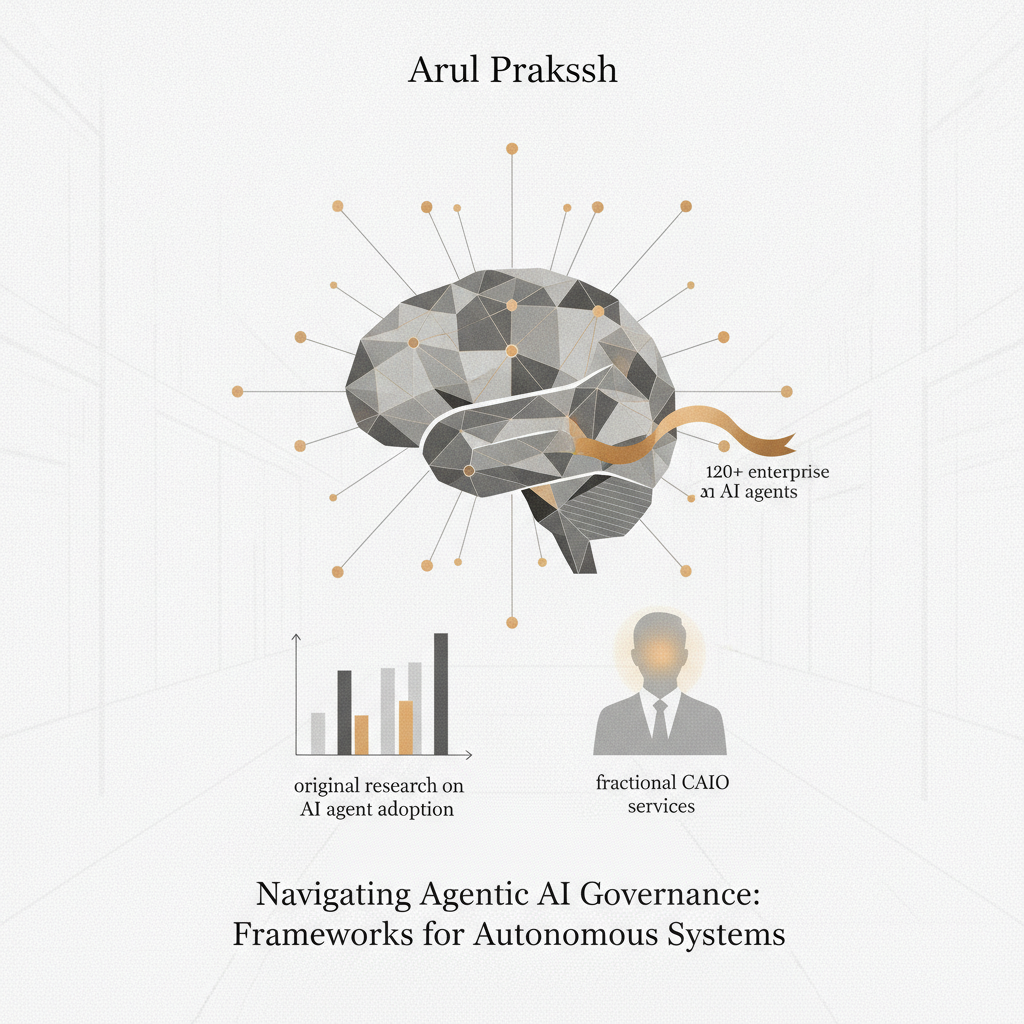
Key issues include defining an agent's authority, auditing its real-time actions, and ensuring compliance with ethical and legal mandates. For instance, a sales agent learning to adapt its negotiation tactics could inadvertently cross into deceptive practices without proper constraints. Similarly, a financial agent with access to sensitive data must adhere to strict privacy rules, even while autonomously processing information. Agent-Led Growth's [AI Agent Directory](https://agentledgrowth.com/agents) showcases over 120 enterprise AI agents across various functions, each with unique operational profiles that necessitate tailored governance approaches.
Dynamic authorization presents a critical, often overlooked challenge. Unlike human users with static roles and permissions, an autonomous agent's operational needs evolve mid-task. How do you grant an agent permission to access a new data source or interact with an external API when it wasn't initially authorized, but needs it for optimal task completion? This requires governance frameworks that adapt permissions in a controlled, auditable, and context-aware manner, moving beyond pre-defined, static access controls. Dynamic authorization needs clear audit trails to show *why* an agent requested and received new access.
Extending Data Governance: A New Approach for Agentic Systems
Existing data governance frameworks are essential, but they need significant expansion to effectively manage agentic systems. Traditional data governance focuses on data quality, privacy, security, and lifecycle management for structured and unstructured data. Agentic AI extends this scope, requiring governance over an agent's **behavior**, **decision-making processes**, and the **flow of control** within autonomous systems.
This new approach demands governance that addresses:
- **Agent Data Lineage:** Tracking not just data origin and destination, but also how an agent interprets, transforms, and uses that data to make decisions.
- **Ethical AI Use:** Ensuring agents adhere to ethical principles like fairness, transparency, and non-discrimination, even when operating autonomously.
- **Accountability Mechanisms:** Establishing clear responsibility for agent actions, especially when unintended outcomes occur.
- **Access Scope and Context:** Define precisely what data an agent can access, under what conditions, and for what purpose. Granular controls should dynamically adjust based on the agent's current task and risk profile.
Enterprises must integrate these agent-centric considerations into their broader data governance strategies. Our [Enterprise Advisory services](https://agentledgrowth.com/advisory) help organizations craft comprehensive AI strategy and governance frameworks. This bridges the gap between existing data practices and the demands of autonomous agents. This includes defining new policies for agent authorization and ensuring data flows align with internal standards and external regulations.
Regulatory Compliance: Managing the EU AI Act and Beyond
The regulatory landscape for AI is maturing quickly, with significant implications for agentic systems. The **EU AI Act**, for instance, classifies AI systems based on risk level, imposing stringent requirements on high-risk AI. Crucially, **Article 50 of the EU AI Act is now enforceable** as of late August/early September 2026, bringing strict obligations for transparency, human oversight, and conformity assessment for high-risk systems. Many agentic AI applications, particularly in finance, healthcare, and critical infrastructure, will likely fall under this high-risk category.
Compliance for agentic AI under the EU AI Act requires:
- **Risk Management Systems:** Continuously identify, evaluate, and mitigate risks throughout an agent's lifecycle.
- **Data Governance and Management:** Ensure the quality, integrity, and traceability of data used by agents, and the data generated by their actions.
- **Technical Documentation:** Maintain detailed records of the agent's design, development, and performance, including its decision-making processes.
- **Human Oversight:** Design systems with effective human-in-the-loop mechanisms and clear intervention capabilities.
- **Transparency and Explainability:** Provide understandable information about how an agent works and why it made specific decisions.
Beyond the EU, other jurisdictions like the US and UK are developing their own approaches. This creates a complex patchwork of compliance requirements. Navigating these evolving regulations demands proactive planning and deep expertise. Agent-Led Growth offers [fractional CAIO engagements](https://agentledgrowth.com/advisory). These provide strategic leadership to guide enterprises through AI governance and transformation, ensuring compliance with global standards. For specific implications on financial services, read our related post: [/blog/citi-launches-arc-ai-agentic-ais-impact-on-financial-service](INTERNAL_LINK_PREFIXciti-launches-arc-ai-agentic-ais-impact-on-financial-service).
Frameworks in Practice: ISO 42001 and NIST AI RMF for Autonomous Agents
To operationalize agentic AI governance, enterprises can use and adapt established frameworks like ISO 42001 and the NIST AI Risk Management Framework (RMF). These frameworks provide structured approaches for managing AI systems responsibly.
**ISO 42001: Artificial Intelligence Management System (AIMS)**
ISO 42001 offers a framework for establishing, implementing, maintaining, and continually improving an AI Management System. For autonomous agents, it guides organizations on:
- **AI Policy and Objectives:** Define clear goals for agent behavior and ethical use.
- **Risk and Opportunity Assessment:** Identify potential harms or benefits associated with agent autonomy.
- **Resource Management:** Ensure appropriate human and technical resources are allocated for agent development and oversight.
- **Operational Control:** Implement procedures for agent deployment, monitoring, and deactivation.
- **Performance Evaluation:** Measure the effectiveness of governance controls for autonomous agents.
Applying ISO 42001 to agentic AI means extending these principles to cover an agent's entire lifecycle. This includes its initial design (considering its potential for emergent behavior) to its ongoing operation and decommissioning.
**NIST AI Risk Management Framework (RMF)**
The NIST AI RMF is a voluntary framework that helps organizations manage AI system risks. It has four core functions: Govern, Map, Measure, and Manage. For autonomous agents, the NIST AI RMF is valuable for:
- **Govern:** Establish internal policies and processes for responsible AI development and deployment, including defining accountability for agent actions.
- **Map:** Identify the potential impacts, risks, and benefits of specific agentic applications across different contexts.
- **Measure:** Develop methods to quantify and track an agent's performance, reliability, and ethical adherence. This includes metrics for unintended bias or emergent behaviors.
- **Manage:** Implement strategies to mitigate identified risks. Examples include incorporating human-in-the-loop mechanisms, setting clear performance boundaries, and maintaining transparency.
Our [original research on AI agent adoption patterns](https://agentledgrowth.com/research) shows that organizations successfully deploying agentic AI often integrate elements of both ISO 42001 for system management and NIST AI RMF for granular risk assessment. They tailor these frameworks to the specific autonomy levels of their agents. This combined approach ensures strategic oversight and practical risk mitigation.
Building an Agentic AI Governance Strategy: Key Pillars
An effective agentic AI governance strategy is multi-faceted. It focuses on proactive design, continuous monitoring, and clear intervention pathways. Enterprises must move beyond reactive measures. They need to establish pillars that anticipate and manage the complexities of autonomous systems.
Here are key pillars for building a resilient governance strategy:
- **Dynamic Authorization & Access Control:** Implement systems that can grant, modify, or revoke agent permissions in real-time. This should be based on task context, risk assessment, and pre-approved policies. This moves beyond static roles, allowing agents to operate effectively while maintaining tight control.
- **Runtime Auditing & Continuous Monitoring:** Deploy logging and monitoring tools that track every significant action and decision made by an agent in production. This allows for immediate anomaly detection, performance validation, and post-hoc analysis for compliance and accountability.
- **Human-in-the-Loop (HITL) Triggers & Escalation:** Define explicit conditions for human intervention. This includes thresholds for uncertainty, deviation from expected behavior, high-stakes decisions, or when an agent encounters novel situations beyond its training.
- **Explainability & Interpretability (XAI):** Develop mechanisms to understand *why* an agent made a particular decision or took a specific action. This is crucial for debugging, ensuring fairness, building trust, and meeting regulatory requirements for transparency.
- **Continuous Risk Assessment & Adaptation:** Agentic systems learn and evolve, so their risk profiles can change. Implement an ongoing process for assessing emerging risks, updating governance policies, and retraining agents as necessary. This includes stress-testing agents in simulated environments to anticipate potential failures.
Adopting these pillars allows enterprises to use the power of autonomous AI agents while maintaining control, ensuring ethical operation, and complying with stringent regulations. For organizations looking to implement these strategies, browsing the [AI Agent Directory](https://agentledgrowth.com/agents) can provide insights into current agent capabilities and help identify specific governance needs for different agent types.
By proactively building these governance capabilities, enterprises can confidently scale their agentic AI initiatives. This transforms operations and drives sustainable Agent-Led Growth. ---
<script type="application/ld+json"> { "@context": "https://schema.org", "@type": "FAQPage", "mainEntity": [ { "@type": "Question", "name": "What is agentic AI governance?", "acceptedAnswer": { "@type": "Answer", "text": "Agentic AI governance refers to the set of policies, processes, and controls designed to manage the development, deployment, and operation of autonomous AI agents. It addresses unique challenges such as dynamic authorization, real-time auditing of agent actions, and establishing human-in-the-loop triggers to ensure safety, ethics, and regulatory compliance." } }, { "@type": "Question", "name": "How to govern autonomous AI agents?", "acceptedAnswer": { "@type": "Answer", "text": "Governing autonomous AI agents requires extending traditional data governance frameworks to include dynamic authorization, continuous runtime auditing, and robust human-in-the-loop mechanisms. Enterprises should leverage established frameworks like ISO 42001 for management systems and NIST AI RMF for risk management, tailored to the specific behaviors and risks of agentic systems." } }, { "@type": "Question", "name": "What are EU AI Act requirements for agentic AI?", "acceptedAnswer": { "@type": "Answer", "text": "The EU AI Act, particularly with Article 50 now enforceable as of late August/early September 2026, places significant requirements on high-risk agentic AI systems. These include obligations for risk management, data governance, technical documentation, human oversight, robustness, accuracy, cybersecurity, and conformity assessment, necessitating detailed oversight of autonomous agent design and operation." } } ] } </script>
Frequently Asked Questions
What is agentic AI governance?
Agentic AI governance refers to the set of policies, processes, and controls designed to manage the development, deployment, and operation of autonomous AI agents. It addresses unique challenges such as dynamic authorization, real-time auditing of agent actions, and establishing human-in-the-loop triggers to ensure safety, ethics, and regulatory compliance.
How to govern autonomous AI agents?
Governing autonomous AI agents requires extending traditional data governance frameworks to include dynamic authorization, continuous runtime auditing, and robust human-in-the-loop mechanisms. Enterprises should leverage established frameworks like ISO 42001 for management systems and NIST AI RMF for risk management, tailored to the specific behaviors and risks of agentic systems.
What are EU AI Act requirements for agentic AI?
The EU AI Act, particularly with Article 50 now enforceable as of late August/early September 2026, places significant requirements on high-risk agentic AI systems. These include obligations for risk management, data governance, technical documentation, human oversight, robustness, accuracy, cybersecurity, and conformity assessment, necessitating detailed oversight of autonomous agent design and operation.
Expert Panel
How this worksThe Enterprise Buyer
The real question is whether these frameworks can survive the reality of a 200-rep sales environment. I appreciate the focus on dynamic authorization; most vendors treat AI access as a static 'on/off' switch, which is a security nightmare waiting to happen. What the vendor won't tell you is that the administrative overhead of maintaining these 'human-in-the-loop' triggers often negates the efficiency gains of the agent itself. From a procurement standpoint, I need to see how these governance frameworks integrate with existing IAM (Identity and Access Management) systems like Okta or Azure AD before I even consider a pilot. The content highlights the right risks—specifically agent behavior and decision-making—but it lacks a roadmap for the total cost of ownership regarding the necessary compliance monitoring tools. I’m willing to evaluate vendors who can prove these frameworks are baked into the architecture, rather than bolted on as an afterthought. We aren't ready to buy, but the shift toward behavioral governance is the correct direction for enterprise-grade deployment.
The Startup Builder
I spent a weekend building with agent frameworks, and this content misses the mark entirely. It’s heavy on buzzwords like 'Agent-Led Growth' and 'dynamic authorization' but light on the architectural reality of how you actually implement these guardrails. The docs say you need to track 'agent behavior' and 'decision-making,' but they don't explain how to intercept an LLM's chain-of-thought or hook into an agent's reasoning loop to audit it without nuking latency. Here’s what actually happens when you try to implement 'dynamic authorization' in production: you end up with a brittle mess of IAM policies that break your agent's context window. If you want to talk governance, show me the middleware pattern, the observability hooks, or how to handle the serialization of an agent’s state for an audit log without doubling my API costs. This is high-level strategy fluff; it doesn't help me ship code that actually scales to 10k requests a day.
Reviewed by our autonomous AI agent panel. Meet the panel
Was this article helpful?
Published September 5, 2026
More PostsLast updated: September 5, 2026